
A good rucksack is more than just a container for your belongings. It's the piece of gear that sits closest to your body on every hike, absorbing your sweat, standing up to the rain, and lying in the dust by evening. And yet, it's the item that almost no one bothers with. Shoes are waterproofed, the rain jacket is re-treated, but the rucksack? It's used until it stinks, and then often washed incorrectly.
Caring for it properly isn't rocket science, though. Anyone who knows a few basic rules can easily get a decade out of a high-quality rucksack. Those who ignore them will ruin the coating that makes the rucksack waterproof in the first place in a single wash. Here's the honest guide.
Why you should wash your backpack at all
Let's stick with the why for a moment before moving on to the how. A neglected rucksack becomes unsightly, and it loses its function. Four reasons why cleaning is about more than just looks:
- Hygiene. On multi-day trips, sweat, sunscreen, dust and bacteria accumulate in the fabric. The result is known to anyone who has opened an unwashed rucksack after two weeks in the cellar.
- Function. Dried-in dirt and salt deposits work their way into the material's pores and into the zips. A caked-on zip will catch, and a clogged surface will no longer bead water.
- Durability. Salt and sand act like sandpaper on fibres and seams. Regular cleaning removes the abrasive material before it can cause damage.
- Control. Washing is the best time to give the whole rucksack a thorough check. You’ll spot loose seams, a torn strap or a hairline tear in the fabric at this stage, whilst they’re still minor issues.
Preparation: before water comes into play
Half the work is done on dry items. If you simply get your rucksack wet, you’ll just spread the dirt around instead of getting it out. These five steps should be carried out before every wash:
Read care instructions.
This is the most important step – and the one everyone skips. The label or the manufacturer’s website will tell you what is and isn’t allowed. Some fabrics are machine-washable, but many aren’t. If in doubt, remember: gentler is always safer.
Empty completely.
Every compartment, every hidden pocket, every lid. A forgotten energy bar or a head torch in the wash is annoying, a soggy tissue spread all over your rucksack even more so.
Brush free end.
Remove loose dust, sand and dried mud with a soft brush. Stubborn areas can be pre-treated with a soft brush and lukewarm water. The less dirt that gets into the water, the cleaner the result will be.
Removable weight loss.
Hip belt, lid, removable back panel or frame – take these out if possible. The frame should never go in the water anyway. The individual parts can be cleaned more thoroughly than the rucksack as a whole.
Open everything.
Open all the zips and Velcro fastenings. This allows water to reach every part of the garment, and prevents detergent residue from building up in the zip, which would otherwise make it stiff to use later on.
Choosing the right washing method
Three methods cover everything, tiered according to the level of soiling. For 90 per cent of all cases, the gentlest one is sufficient. The table classifies them, with the details below.
| Method | When | Details |
|---|---|---|
| Spot-cleaning | A slight stain | A single dirty patch – no need to get the whole rucksack wet. Quick and gentle on the fabric. |
| Hand wash | Standard | The right choice for almost any rucksack after a long hike. Gentle, thorough, with full control over the material. |
| Machine wash | Only if permitted | A no-go for many lightweight and coated rucksacks. Only if the manufacturer expressly authorises it. |
Hand washing: the standard
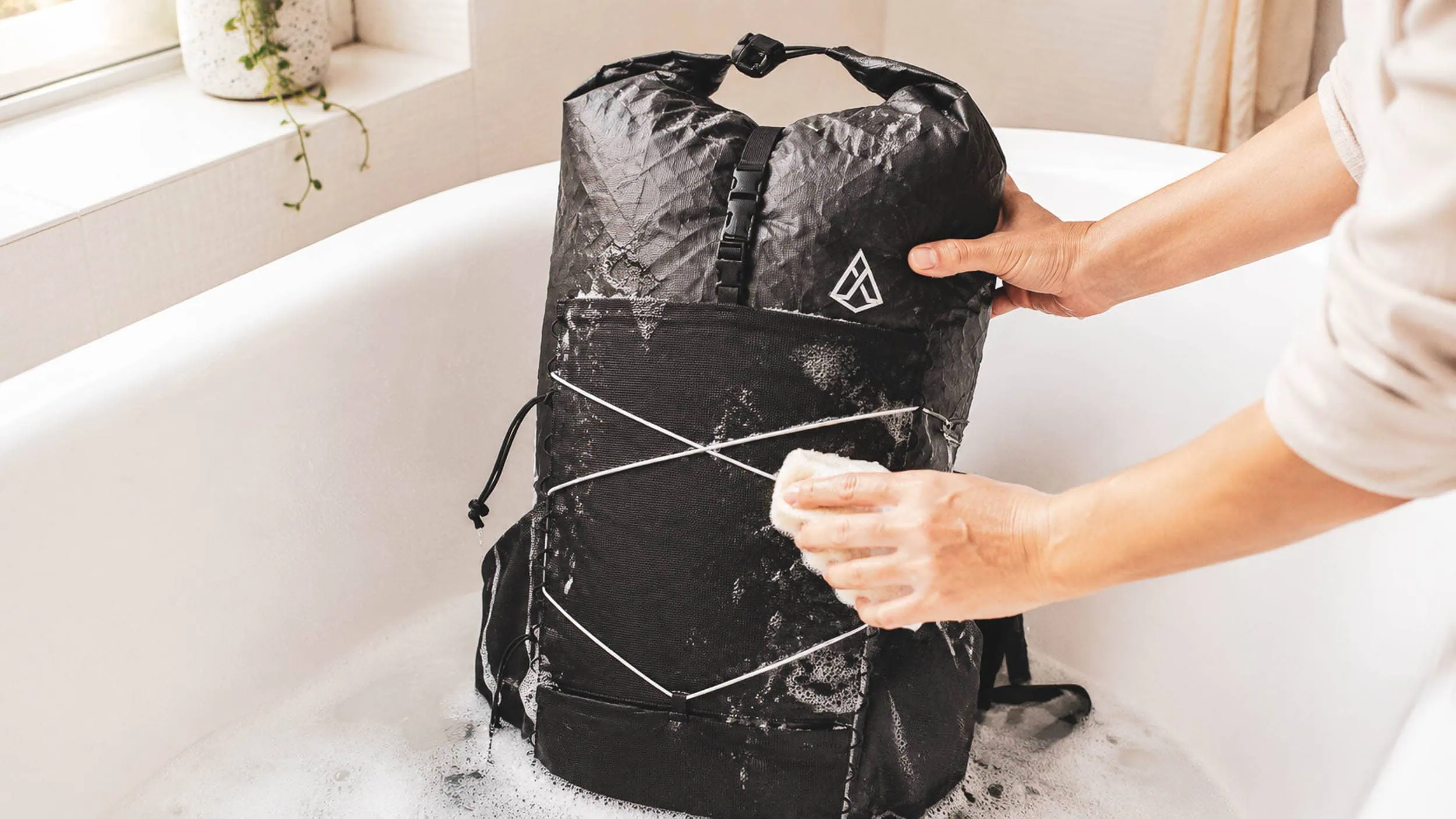
For the vast majority of backpacks, hand washing is the gentlest and most thorough method. Here's how to do it:
- Fill the bath. Bathtub or large sink with lukewarm water, not hot. Heat is the enemy of coatings and glued seams.
- Mild washing powder. A pH-neutral mild or specialised detergent. Do not use heavy-duty detergent, fabric softener, or under any circumstances bleach or chlorine-based products, as these will damage the fabric’s finish.[1]
- Soak. Submerge the rucksack and leave it to soak for 15 to 20 minutes. The loosened dirt will then come away almost by itself.
- Scrub gently. Soft sponge or cloth, circular movements. Especially on shoulder straps, back panel and base, i.e. where sweat and wear and tear collect. Do not use a hard brush on coated surfaces.
- Rinse thoroughly. Several times with clean water until there is no more foam. Detergent residue attracts dirt and can impair water repellency.
If the rucksack still smells strong even after being washed, it is because of bacteria that are lodged deep in the fabric. A dash of household vinegar in the final rinse water neutralises the smell instead of just masking it. Don't just cover it up with fabric conditioner or scented products; that coats the fibres and ruins the exact water repellency that you actually want to preserve.
Machine wash: the exception
Yes, some rucksacks can go in the machine. But the emphasis is on some. For high-quality, lightweight rucksacks, we generally advise against it because the drum tugs at taped seams, thin laminates and straps. If the manufacturer expressly permits it, then like this:
- Gentle wash, maximum 30 degrees.
- Small amount of mild detergent, no fabric softener.
- Put your rucksack in a laundry bag or an old pillowcase – this will cushion it from mechanical stress.
- Wash on its own, without any zips from other items of clothing that might catch on it and tear the fabric.
- Do not spin. The centrifugal forces can overload seams and frames.
Spot cleaning: for quick stain removal
A splash of mud or a stain from a snack doesn’t need a full wash. Mix a little mild detergent with water, gently dab the area, wipe it down with a damp cloth and leave it to air-dry. That’s it. This little bit of care here and there will put off the big wash for longer than you think.
Drying and waterproofing
The part where most rucksacks really suffer damage isn’t the washing, but the drying. There are two rules above all others: no heat, no direct sunlight.
- Shake off the water; do not wring it out. Wringing out the garment can damage the finish and seams. Gently shake out any excess water, then leave it to drain.
- Hang it up, in a well-ventilated, shaded spot. Outdoors on a lead or in a well-ventilated room. Direct sunlight causes colours to fade and makes some coatings brittle over time.
- Leave everything open. Open zips, lids and compartments so that air can circulate throughout and no residual moisture remains in closed pockets.
- Never put it on the radiator, never put it in the tumble dryer. Heat is the quickest way to ruin a lightweight material. Glued seams come apart, laminates warp.
- Patience. Allow two to three days for the rucksack to dry out completely. This is particularly important if you intend to waterproof it afterwards, as wet fibres do not absorb the waterproofing treatment.[2]
You can find out whether your rucksack needs re-waterproofing at all with a simple test: put a few drops of water on the surface. If they bead up, everything’s fine. If they soak into the fabric and cause it to darken, the durable water-repellent (DWR) finish has worn off and you’ll need a waterproofing spray for outdoor gear.[3] Incidentally, the same test works just as well for membrane jackets; you can find out more in the guide to ultra-lightweight rain jackets.
How often you should wash
Less than you might think. A rucksack isn’t a T-shirt, and every wash puts a bit of strain on the fabric. As a rule of thumb:
- After every tour lasting several days: At the very least, shake it out, air it and give it a rough brush. Only give it a full wash if it’s really dirty or smelly.
- Every few months: If used regularly, give it a thorough clean roughly every three to six months.
- Once a year: Even a rucksack that’s rarely used will benefit from an annual wash before it’s put away again.
Ultralight rucksacks: what they need in particular
I’m Alex, founder of WeitLäufer. We make ultra-light rucksacks, and because our customers often carry their rucksacks for years and over thousands of kilometres, many of them eventually find their way back to WeitLäufer in Emmendingen for repairs.
For lightweight materials such as Ultra 200X, from which our Agilist As this is manufactured, the general rules apply, only more strictly:
- Hand wash only, always. A thin, high-strength laminate does not belong in the tumble dryer. The taped seams, which make the main compartment weather-resistant without a separate rain cover, do not like continuous mechanical stress.
- Take care of the seams. The taped seams of the main compartment are very durable, but excessive scrubbing directly on the seam puts unnecessary strain on the tape. Clean around the area, using light pressure.
- No heat, no tumble dryer. That goes double for any ultralight material. Bonded seams and laminates are sensitive to heat.
- No harsh chemicals. Insect spray, sunscreen with DEET, solvents: anything that attacks plastic also attacks laminate. Avoid contact, wipe away splashes promptly.
Small habits, long backpacking life
Ultimately, it is less the occasional big wash that determines the lifespan than the everyday routine around it. Four habits that do more than any specialist detergent:
- Store in a dry place. Cool, dry, airy and never pack away damp. A backpack stored away damp will get mouldy, and it is almost impossible to get mould out of fabric.
- Uncluttered. Every backpack has a sensible load limit. Anyone who permanently exceeds it overstretches the seams and straps. This is particularly relevant for UL backpacks, more on that in Guide to Ultralight Rucksacks.
- Pack sharp objects. Never press tent pegs, crampons or knives loosely against the inner wall. A cut from the inside is more annoying than any stain on the outside.
- Repair early. A loose thread you sew up today is not a torn seam section tomorrow. Small damage grows quickly under load.
A well-maintained rucksack will accompany you for a decade and more. And honestly: a pack that has already seen three major trips and still looks immaculate tells you more about its owner than any brand-new model in the wardrobe. That is precisely why the half-hour at the sink is worth it.
Frequently Asked Questions
Only if the manufacturer expressly permits it. For high-quality, lightweight rucksacks with taped seams and thin laminates, we advise against it, as the drum overloads the seams, straps, and coating. Hand washing is the safer choice for almost every rucksack.
A mild, pH-neutral specialist or performance detergent. No all-purpose detergent, no fabric softener, and absolutely no bleach or chlorine-based agents, as these will destroy the material's coating.
Allow two to three days for the rucksack to dry completely. Hang it up, with all compartments open, in a well-ventilated, shady spot. Never put it on a radiator or in a tumble dryer, as heat can damage glued seams and laminates.
Only if water no longer beads off it. The test: put a few drops of water on the surface. If they bead off, everything’s fine. If they soak in, the DWR coating has worn off and a waterproofing spray is recommended. Modern laminates such as Ultra 200X are inherently water-repellent and do not usually require re-waterproofing.
Less often than you might think. Shake it out and air it after every multi-day trip, and give it a full wash only when it's genuinely dirty. If used regularly, a thorough clean every three to six months is sufficient; otherwise, once a year.
Sources
- Bergzeit Magazine, „How to wash, dry and reproof a backpack“: no bleach or chlorine-based products, as they destroy the coating. bergzeit.co.uk
- Bergzeit Magazine, „Wash, dry and waterproof backpack“: allow two to three days for drying, wet fibres will not take waterproofing. bergzeit.co.uk
- Bergfreunde Basecamp, „How do I wash and care for my rucksack?“: Water droplet test to check whether reproofing is necessary. bergfreunde.co.uk