An honest Camino de Santiago packing list begins with a question: how much of what the usual lists recommend do you actually need? Anyone searching for „Camino backpack“ for the first time will almost everywhere end up at 40 litres and more. The 40 litres come from the Camino Francés, where you sleep in pilgrim hostels for weeks and carry everything yourself. On most German routes, the situation is different, and that changes the packing list from the ground up.
Here at WeitLäufer, we make ultra-light rucksacks, and the most common thing we hear from hikers is: „I took far too much with me.“ That’s exactly what this article is about. The aim is to have a rucksack that carries only what the hike actually requires.
How big does a rucksack for the Camino really need to be?
The common recommendation in most pilgrim guidebooks is between 30 and 45 litres.[1] That is not wrong, but it is calculated for the worst-case scenario: complete self-sufficiency, own sleeping bag, staying overnight in a dormitory. As soon as you sleep in guesthouses, hotels or monasteries, a large part of this equipment is no longer needed. And that is precisely the norm on the German Caminos.
Experience shows that 25 to 30 litres is easily enough for a pilgrimage tour with fixed accommodation every night. That sounds like little, but it's enough for a change of clothes, rain gear, hygiene products, food for the day and a small buffer. More important than the volume itself is what it does to your packing habits.
A 45-litre rucksack is rarely half empty when you're out and about. The free space invites you to pack something else „just in case“, and in the end you're carrying three kilos that you never need. A smaller rucksack brings discipline. You make a conscious decision about every single item, instead of letting it casually vanish into the volume.
St. James's Way packing list: what really belongs in it
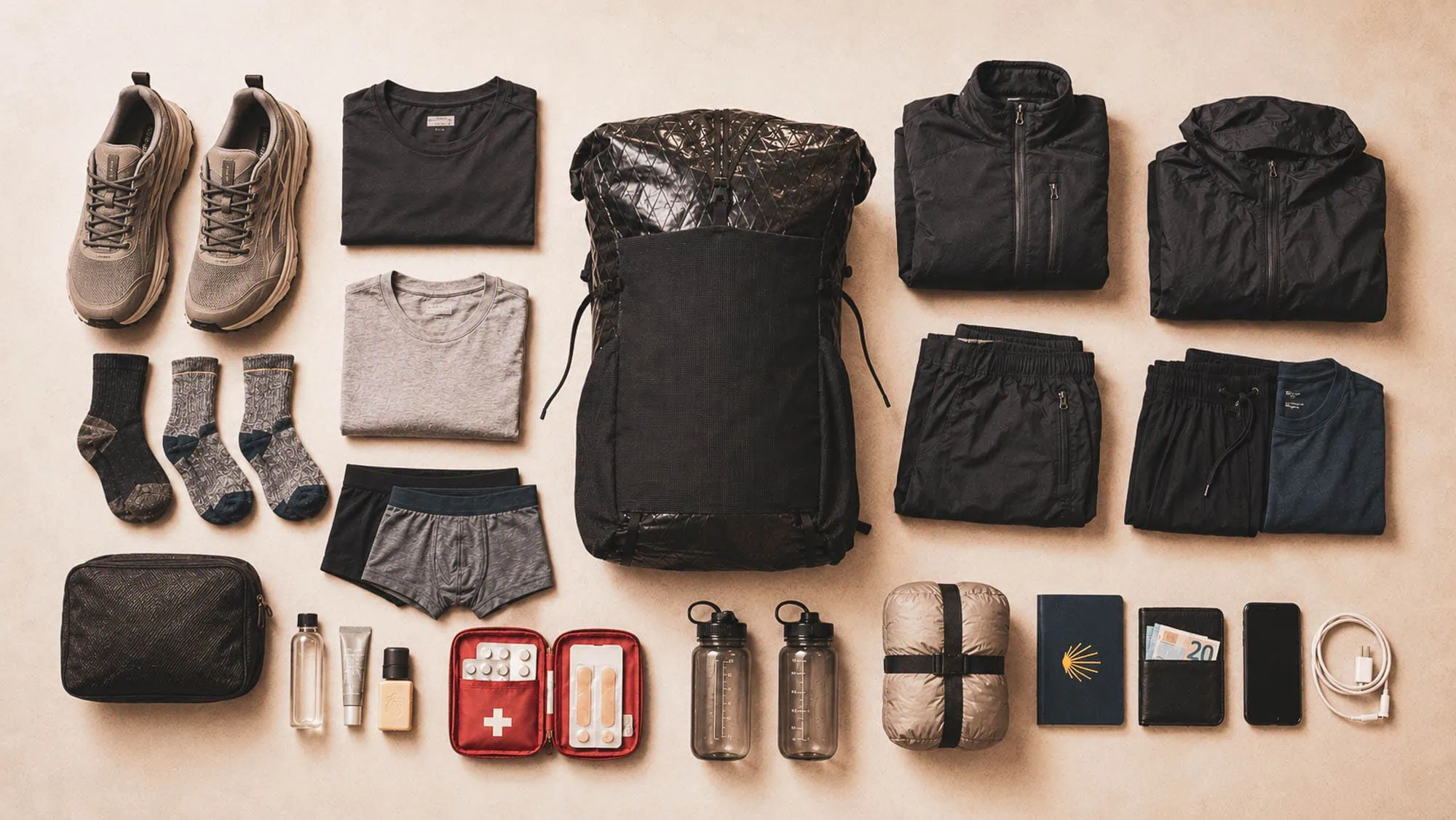
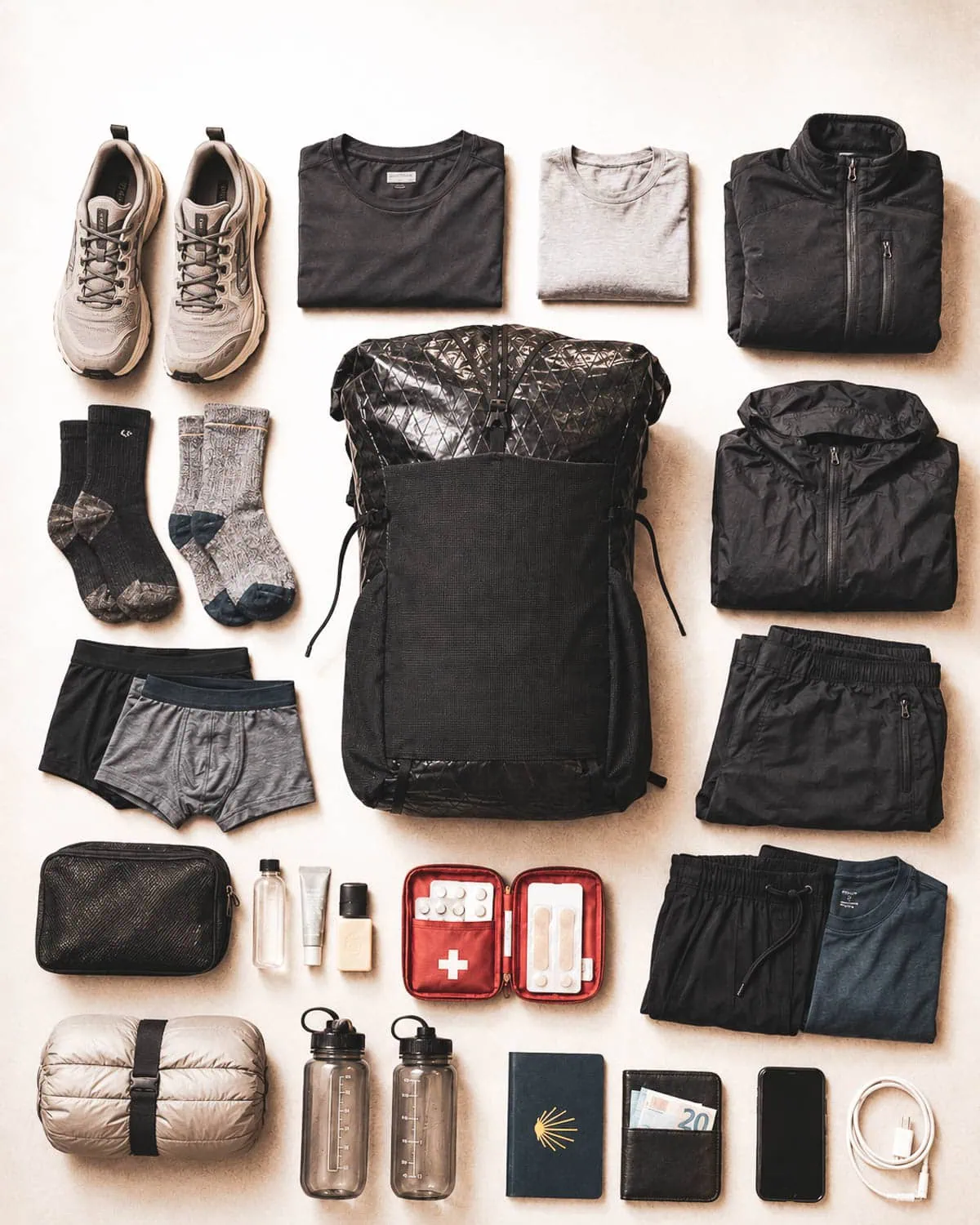
The following packing list is designed for a multi-day tour with fixed accommodation, i.e. the typical German Way of St. James. It is deliberately kept brief. Anything not listed here is, in case of doubt, ballast.
| Item | Number | Comment |
|---|---|---|
| Hiking boots or trail runners | 1 | Walked in, a half size bigger really (feet swell on long stages). |
| Merino hiking socks | 2 | One on the foot, one for changing. Merino barely smells even after three days. |
| Performance shirt | 1 | Worn. Merino or synthetic, no cotton shirt. |
| Wanderhose | 1 | Lightweight, quick-drying. |

| Item | Number | Comment |
|---|---|---|
| Reversible shirt | 1 | Enough. Wash in the evening, it dries overnight. |
| Spare socks | 1 | Dry socks are the best blister prevention. |
| Underwear | 2 to 3 | Quick-drying, wash out in the evening. |
| Insulating layer | 1 | Lightweight fleece or down jacket for breaks and evenings. |
| Rain protection | 1 | Rain jacket or poncho, depending on preference. A poncho also covers your backpack. |
| Light evening wear | 1 Set | So you can get out of your sweaty clothes. |
| Wash bag minimal | 1 | Travel-sized, bar of pure soap for body and laundry. |
| First Aid and Blister Plasters | 1 | Blister plasters are the most important single item on the Camino. |
| Pilgrim's passport and document | 1 | ID, some cash, mobile phone, charging cable. |
| Drinking system | 1.5 to 2 L | Bottle or bladder. Easily refillable in Germany. |
Sleeping bag: yes or no?
On the German Camino routes, you sleep in hotels, guesthouses, or monasteries, meaning in real beds with bedding. You won't need a sleeping bag there. If you want to be on the safe side, take an ultra-lightweight liner made of silk or microfibre with you; it weighs next to nothing and fits in your fist. A proper sleeping bag only belongs in your rucksack if you are genuinely staying in hostels or camping, and this is the exception in Germany.
Layering clothes
You wear most of your clothing, the backpack only carries the change of clothes. Three layers are enough: a functional base layer on your skin, insulation for breaks, and rain protection on the outside. Leave cotton at home, as it holds onto sweat and rain and takes forever to dry. Two shirts and two to three pairs of socks and underwear are enough for any number of days because you wash them out in the evening. Which ultralight rain jacket is worth it for pilgrimage can be read in our Waterproof jacket buying guide.
Hygiene, paperwork and odds and ends
This is where the secret weight culprits gather. Full shampoo bottles, the thick book, the second camera. Travel-sized items, a bar of soap for body and laundry, the book on your phone. Don't forget the pilgrim's passport, with its stamps (Sellos) marking your stages, which secures your certificate at the destination.
The 10 percent weight limit and how to maintain it
The most useful rule of thumb when hiking.[2] At a body weight of 75 kg, that's about 7 to 8 kg. Sounds ambitious, but it's quite doable with a bit of discipline, and your body will notice the difference by the third day at the latest, when the first pilgrims start complaining about their knees and shoulders.
Weigh everything before you pack.
A kitchen scales costs very little and is the most honest packing tool. Only when you know that your „light“ towel weighs 200 g can you decide whether it comes along.
A pack for three days, not for thirty.
You wash as you go. More clothes won't make the tour safer, just heavier. Two shirts are enough for the whole trip.
Eliminate packaging.
Shampoo into the 30ml bottle, sun cream into the travel-sized container, the book onto the phone. This quickly saves several hundred grams in total.
Dispense water, don't hoard it.
In Germany you can find drinking water almost everywhere. You rarely need a capacity of more than two litres on German trails. One litre weighs a kilo.
Delete every duplication.
A knife, a jacket, a pair of spare socks. Anyone who packs double „just in case“ is walking their fear around, not the solution.
If you honestly go through these five points, you'll almost automatically arrive at a setup that fits within 25 to 30 litres and stays under 8 kg. You can find the detailed methodology on how to systematically reduce your base weight in our Lightweight packing list and in the Ultralight Trekking Guide.
| Block | Weight |
|---|---|
| Rucksack (empty, small ultralight model) | ~600 g |
| Clothes in the rucksack | ~1.500 kg |
| Sleep, hygiene, first aid | ~1.200 g |
| Electronics and documentation | Around 700 g |
| Water and packed lunch | ~2.500 kg |
| PACKED TOTAL | 6.5 kg |
German Routes to Santiago: Munich and Franconia
Anyone making a pilgrimage in Germany has a free choice among dozens of routes. Two of the most popular starting points run through Bavaria, and both are well-suited for a first tour with a small backpack, as there are permanent accommodations throughout.
The Munich Way of St. James runs from Munich to Lindau on Lake Constance, around 290 to 313 km depending on the route. It typically takes 11 to 14 daily stages with an average of about 20 to 30 km.[3] It goes through the pre-Alpine region with constant ups and downs, challenging enough for a good day's feeling, but without high mountains. There isn't a dedicated network of hostels like in Spain; you'll stay in guesthouses, hotels, and the occasional monastery, which is why a small backpack is perfect here.
The Franconian Way of St James From Nuremberg to Ulm is around 220 to 224 km in 12 stages, a bit shorter and flatter, marked with a yellow shell on a blue background.[4] A peaceful, culturally rich route through Middle Franconia and Swabia, ideal for beginners.
| Characteristic | Munich to Lindau | Nuremberg to Ulm |
|---|---|---|
| Length | ~290 to 313 km | ~220 to 224 km |
| Stages | 11 to 14 | 12 |
| Character | Alpine foothills, constant ups and downs | flat, rich in culture |
| Season | Mid-March to mid-December | Spring to autumn |
| Accommodation | Hotels, guesthouses, monasteries | Hotels, Guesthouses |

Both routes can be well walked in weekly sections if you don't have time for the whole thing at once. The exact stages, accommodations and stamp points can be found at the pilgrim associations, for Franconia, for example, at the Franconian St. James Society.
When more volume makes sense
To be honest, the small backpack isn't the right choice for every type of pilgrimage. There are clear cases where 25 to 30 litres will be too tight, and then it would be nonsense to stick to a small volume out of principle. Three scenarios shift the limit upwards.
- Genuine self-sufficiency in Spain. On the Camino Francés you sleep in a dormitory, so you need your own sleeping bag, often a liner, and sometimes a thin sleeping mat for an overflow night. Add to that a larger food buffer for the long, infrastructure-sparse stages of the Meseta. That all adds up, and honestly speaking, 35 to 40 litres is what you need here.
- Tent and trekking stages. Once a tent, sleeping mat and full sleep system are brought along, such as on pilgrim routes away from accommodation or combined with trekking, the 40-litre-plus territory begins. Here you are carrying more, and you are carrying more bulky gear, and the volume must neatly swallow the sleep system without everything dangling on the outside.
- Winter, shoulder season and cold high altitudes. Thicker insulation, long underwear, warmer sleeping gear, possibly microspikes. Cold always costs volume. Anyone hiking the foothills of the Alps in March or in late autumn simply packs more than in midsummer.
In all three cases, it's worth going for the larger sibling. Our Agilist is precisely built for these multi-volume tours: 40 litres in the weather-protected main compartment plus 14 litres in the external pockets, a total of 54 litres. The division is worth its weight in gold for pilgrims. The dry items (sleeping bag, change of clothes) go in the main compartment, and items that need to be quickly accessible or can get wet go in the external pockets: rain jacket, water bottle, snacks, the damp poncho after a shower. This way, you don't have to empty the entire rucksack every time.
Choose the capacity based on the actual route. For the classic German pilgrimage route with fixed accommodation, this almost always means: small. As soon as self-catering, camping or cold weather come into play, the Agilist is the more reliable companion. We’ll break down which rucksack is best suited to which use in the Guide to Ultralight Rucksacks Off.

Frequently Asked Questions
For a pilgrimage with fixed overnight accommodation, 25 to 30 litres is sufficient. The often-mentioned 40 litres comes from the Spanish hostel model with self-catering. On the German Camino routes, you'll sleep in hotels and guest houses and will need significantly less volume.
As a rule of thumb, aim for a maximum of around 10 per cent of your body weight, including water and daily provisions. For 75 kg, that's about 7 to 8 kg. With a small backpack and disciplined packing, this target is easily achievable.
As a rule, no. You'll be staying in hotels, guesthouses, or monasteries with bedding. A lightweight sleeping bag liner is enough as a backup. A full sleeping bag is only necessary for dormitory accommodation or camping.
Too much clothing and full packaging. Beginners pack for thirty days instead of three, as you can do laundry on the go. Two shirts and two to three pairs of socks and underwear are enough for any length of trip.
The Franconian Way of St James from Nuremberg to Ulm is a bit more beginner-friendly at around 220 km and with a flatter profile. The Munich Way of St James leads through the pre-Alpine region with more ups and downs. Both have fixed accommodation and are well-suited to a small backpack.
For pilgrims with back or knee problems, luggage transport from accommodation to accommodation can be a sensible option. Then a small daypack with water, snacks and rain protection is sufficient. However, those who pack light anyway usually don't need transport at all.
Sources
- Bergzeit Magazine, „The Camino de Santiago packing list“: Recommendation on rucksack size and weight. bergzeit.co.uk
- Camino de Santiago Coastal Path, Packing List and Backpack Size for Pilgrimage (10% Rule of Thumb). jakobsweg-kuestenweg.com
- Munich Way of St James, Stages and Accommodation (Munich to Lindau). jakobsweg-kuestenweg.com, additionally fernwege.de
- Franconian St. James' Society, St. James' Way Nuremberg to Ulm (Length, Stages, Waymarkers). jakobus-franken.de