
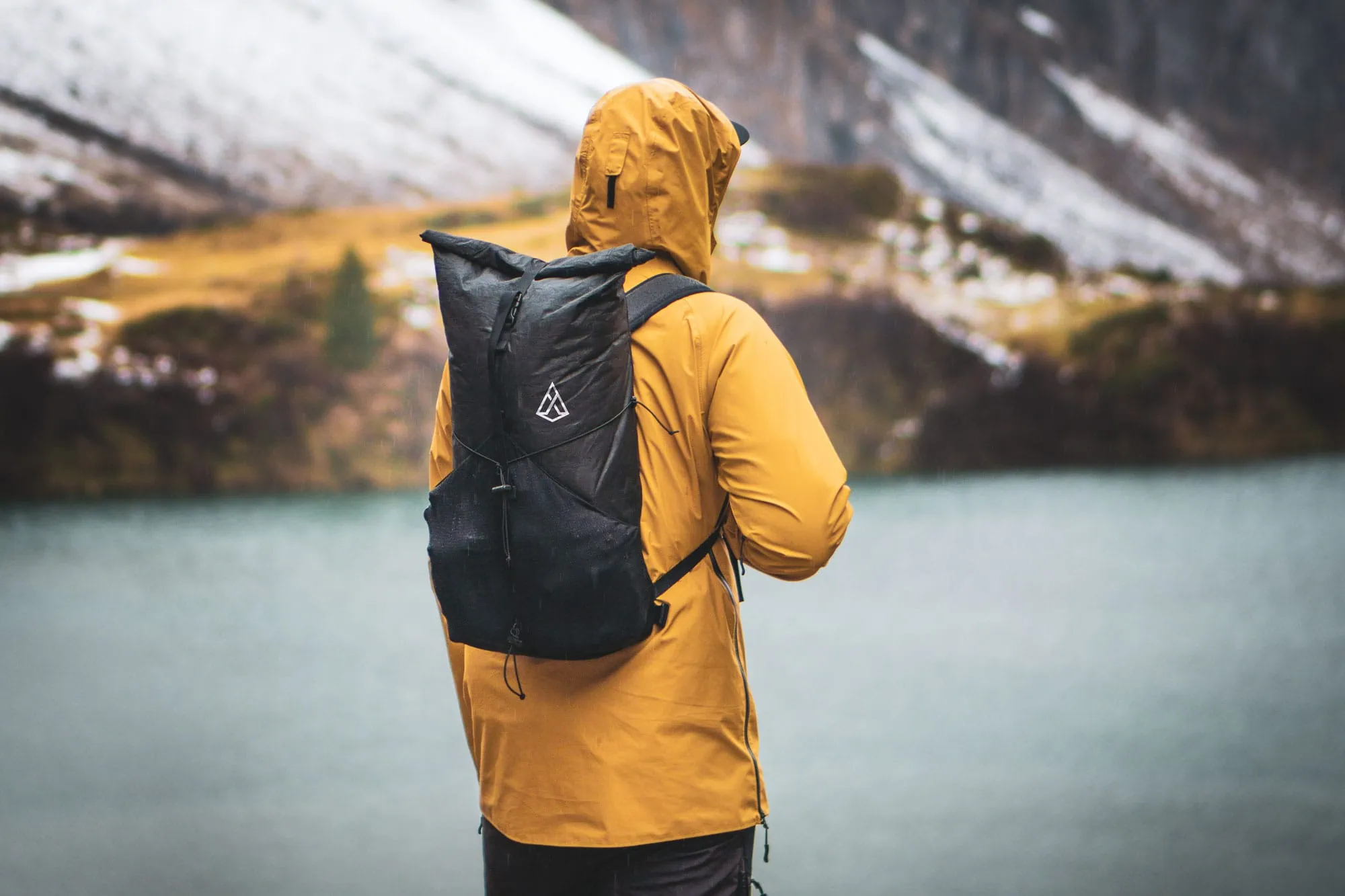
An ultralight waterproof jacket is one of the most essential pieces of kit of all. On nine out of ten days you carry it around unused. On the tenth, however, it is the most important item on your body. Exactly why it is worth looking more closely at this single piece of kit than almost any other: it should weigh as little as possible while the sun is shining, and perform uncompromisingly as soon as it rains.
I have been hiking with rain jackets under 300 grams for over ten years. My Haglöfs LIM accompanied me for 1,900 kilometres in 2017 Alpine crossing accompanied from Vienna to Nice, her predecessor 34 days on the Dream Path Munich Venice. And experience shows: whether a waterproof jacket was worth its money only becomes clear after a few days in continuous rain and on a climb at 90 percent humidity.
This guide explains the technology so that you can read data sheets without falling for marketing hype. Afterwards, we compare specific models weighing from 300 to 97 grams, address the packed-size issue, and look at the PFAS regulations that have been changing the waterproofing of all rain jackets since 2026.
What makes an ultralight waterproof jacket genuinely light
A classic hardshell for mountaineering weighs 400 to 600 grams. Ultralight rain jackets start at around 300 grams and range down to just under 100 grams. The path there involves consistent omission: thinner fabrics, fewer pockets and zips, narrower cuffs and thinner Velcro.
The rule of thumb from my experience: between 150 and 250 grams is the sweet spot for trekking. Here you get a fully-fledged jacket with an adjustable hood and a usable zip, without the fabric becoming too delicate. Anything under 120 grams is specialist kit for gram-counters and is very unforgiving. Anything over 300 grams carries reserves that you rarely need on a summer trekking tour.
Important for context: here, light almost always means minimalist. Anyone looking for a jacket for winter mountaineering with a helmet-compatible hood, pit zips, and thick 70-denier fabric is looking in a different category. For three-season trekking in Central Europe, the lightweight class is more than adequate.

Water column, membrane, layers
The hydrostatic head indicates the water pressure a fabric can withstand before letting water through. According to the DIN EN 343 standard, a material is considered waterproof in the highest class from 1,300 millimetres.[1] It sounds reassuring, but it’s just a lab figure. On the trail, the shoulder straps and hip belt press the jacket firmly against your skin, and under pressure, water seeps through much sooner. When sitting on wet rock, a pressure of roughly 2,000 millimetres of water column is generated. Practical tip: For backpacking with a rucksack you want 10,000 millimetres or more. The established membrane jackets are almost all at 20,000 and upwards, while the 20-euro bargain jacket from the department store is often well below that.
The second thing to look at is the construction of the layers. This reveals more about the character of a jacket than the brand name of the membrane:
| Structure | Character | Classification |
|---|---|---|
| 2-ply | heavy | A membrane with a loose inner lining. This design has all but disappeared in the ultralight sector, as the lining adds weight and bulk. |
| 2.5-layer | lightly damp | Instead of a backing, a printed film protects the membrane. Lightweight and affordable, but it quickly feels clammy against bare skin. The typical compromise of many UL jackets. |
| 3-layer | langlebig | The membrane is firmly laminated between the outer fabric and the inner liner. It feels more comfortable against the skin and is more durable, but is more expensive. It is now also available in weights of under 200 grams. |
And what about the seams? Every seam pierces the waterproof fabric with hundreds of needle stitches. The jacket only becomes waterproof thanks to the tape that is heat-sealed over each seam on the inside. If it’s missing in one place, you’ll have a leak there, no matter how high the fabric’s water column is.
Breathability
Every membrane claims to let sweat escape to the outside. The physical reality is that this only works as long as it’s colder and drier outside than inside. When you’re climbing in constant rain and high humidity, no membrane in the world can keep up with your evaporation. You’ll get wet; the only question is whether it’ll be from the outside or the inside.

That is why I consider mechanical ventilation to be more important than any membrane reading. A full-length front zip that you can open a palm's width when climbing. Wide cuffs to push up your sleeves. On some models underarm zips, the so-called ‘pit zips’. My old Gram Comp II was completely waterproof, but only had a half-length front zip and tight cuffs. In the Brenta Dolomites, it weathered a thunderstorm with hail without complaint; on the sweltering ascent leading up to it, however, I was steaming inside it as if I were in a bag. So for me, the priority is ventilation options first, then membrane performance.

Ultralight rain jacket in a pouch: the packed size
Everyone talks about weight, but packed size is often underestimated. A good ultraleightweight waterproof jacket compresses to the size of a fist, and many models can be stuffed into their own pocket or an included pouch. This changes your behaviour on a trip more than saving 100 grams ever could: the jacket goes into the outside pocket of the backpack instead of deep into the main compartment, and because it is ready to hand in 20 seconds, you actually put it on at the first shower instead of waiting and getting damp.
A word of honesty about those puffer jackets costing between 20 and 30 euros that are sold under precisely this search term: they’re perfectly fine for a stroll around town, a cycle ride to work, and as an emergency spare in your day rucksack. They’re not suitable for trekking. The PU coating often has a water column rating below the strap-pressure threshold, the seams are rarely fully taped, and after a season in your rucksack, the coating flakes off in sticky bits. Anyone heading off on a multi-day trip with luggage should buy from the Diaphragm class from around 100 euros. The additional cost is small when calculated over the product’s lifetime.

A comparison of ultra-lightweight rain jackets: from light to feather-light
The following selection includes jackets that I have worn or weighed myself, supplemented by current models that represent their weight class well. The Montbell Versalite shows the direction of future development: a 3-layer construction with 7-denier nylon at around 181 grams, already featuring a PFAS-free DWR finish.[3] The current Outdoor Research Helium, with its 2.5-layer construction, weighs around 162 grams.[4] Weights refer to men's size M/L; current versions may vary slightly.
| Model | Weight | Practical classification |
|---|---|---|
| Vaude Simony 2.5L | ~300 g | Top of its class. Fully equipped, fairly priced, ecologically sound positioning. For beginners moving on from heavy hardshells. |
| Haglöfs L.I.M GTX | ~240g | My long-term reference: The LIM series has survived around 2,500 Alpine kilometres for me without any material damage. Cut long enough so that it doesn't ride up under the rucksack. |
| Montane Minimus | ~230g | Classic with Pertex Shield membrane and good hood design. Well-balanced all-rounder. |
| Montbell Versalite | ~181 g | 3-layer comfort at a 2.5-layer weight, complete with pit zips and rucksack-compatible pockets. Currently the most well-rounded overall package in its class. |
| Outdoor Research Helium | ~162 g | Minimalist: one chest pocket, no frills. Tried and tested as an always-ready jacket, clammy in continuous wear. |
| Montane Minimus Smock | ~151 g | Half-zip anorak design. Saves weight, costs ventilation and makes putting it on and taking it off a bit of a faff. |
| Berghaus Hyper 100 | ~97 g | Under 100 grams, full-length and with a continuous zip—quite a feat. However, the fabric demands care, so it's not suitable for scrambling tours. |
My recommendation by intended use: For the first multi-day tour with light luggage, take the sweet spot around 200 grams, i.e. Versalite, Minimus or LIM. For pure gram-saving on summer tours with stable weather conditions, a smock or the Hyper 100 is the way to go. If you frequently travel in changeable high-alpine weather, the more durable 3-layer construction pays off.
Details that count on tour
hood
The hood is what separates a decent jacket from a impulse buy. It needs at least one drawstring at the back of the head – preferably two on the sides as well – and a stiffened peak to keep rain out of your glasses. When trying it on, test your peripheral vision: does the hood turn with you, or are you looking at the lining? On exposed paths in windy conditions, that’s exactly what makes the difference between a sure footing and flying blind.
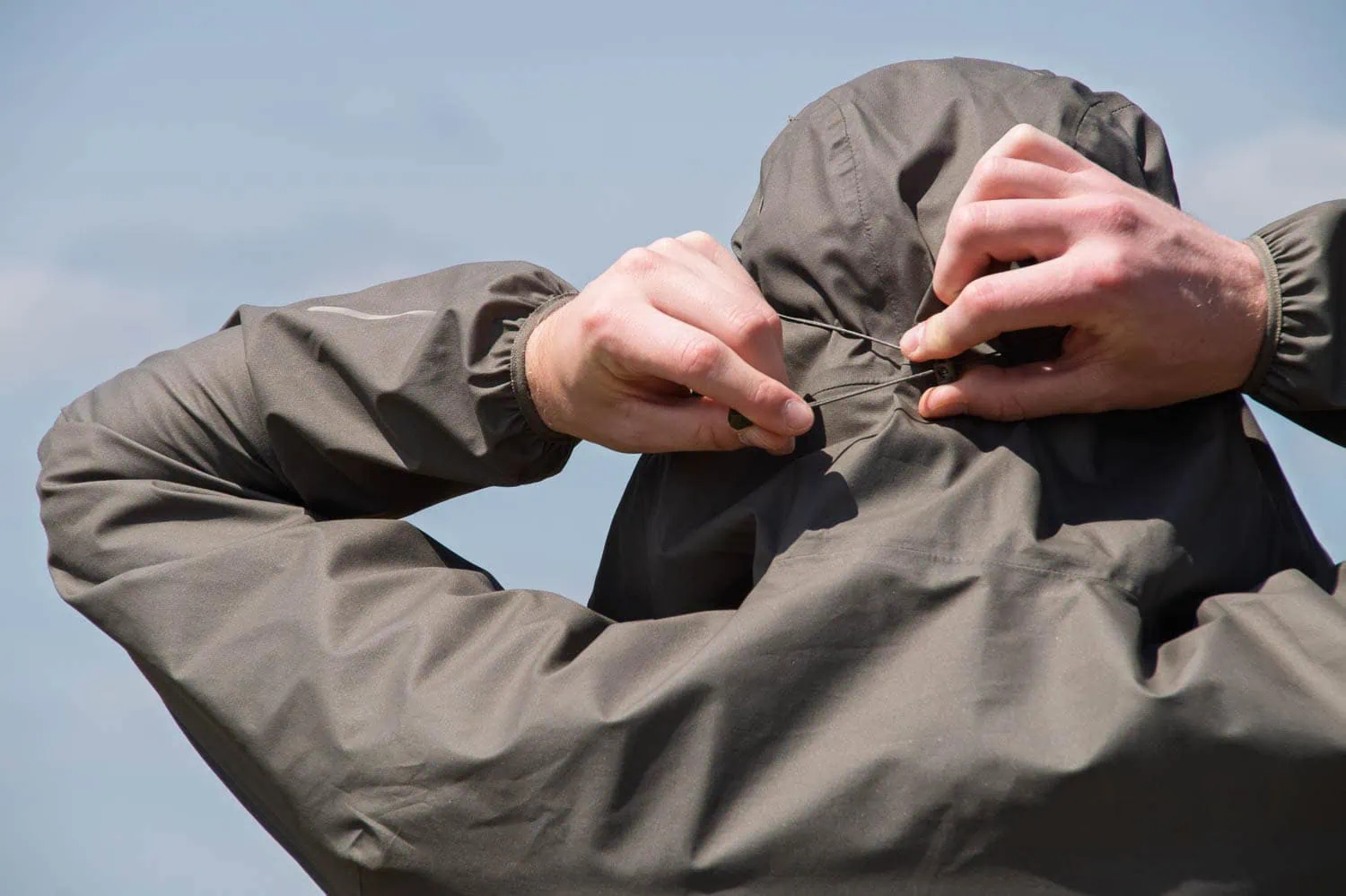

Adjustment strap at the back of the head and stiffened peak. And if the hood doesn't have a good peak, the cap can go underneath.
Bags and waist belts
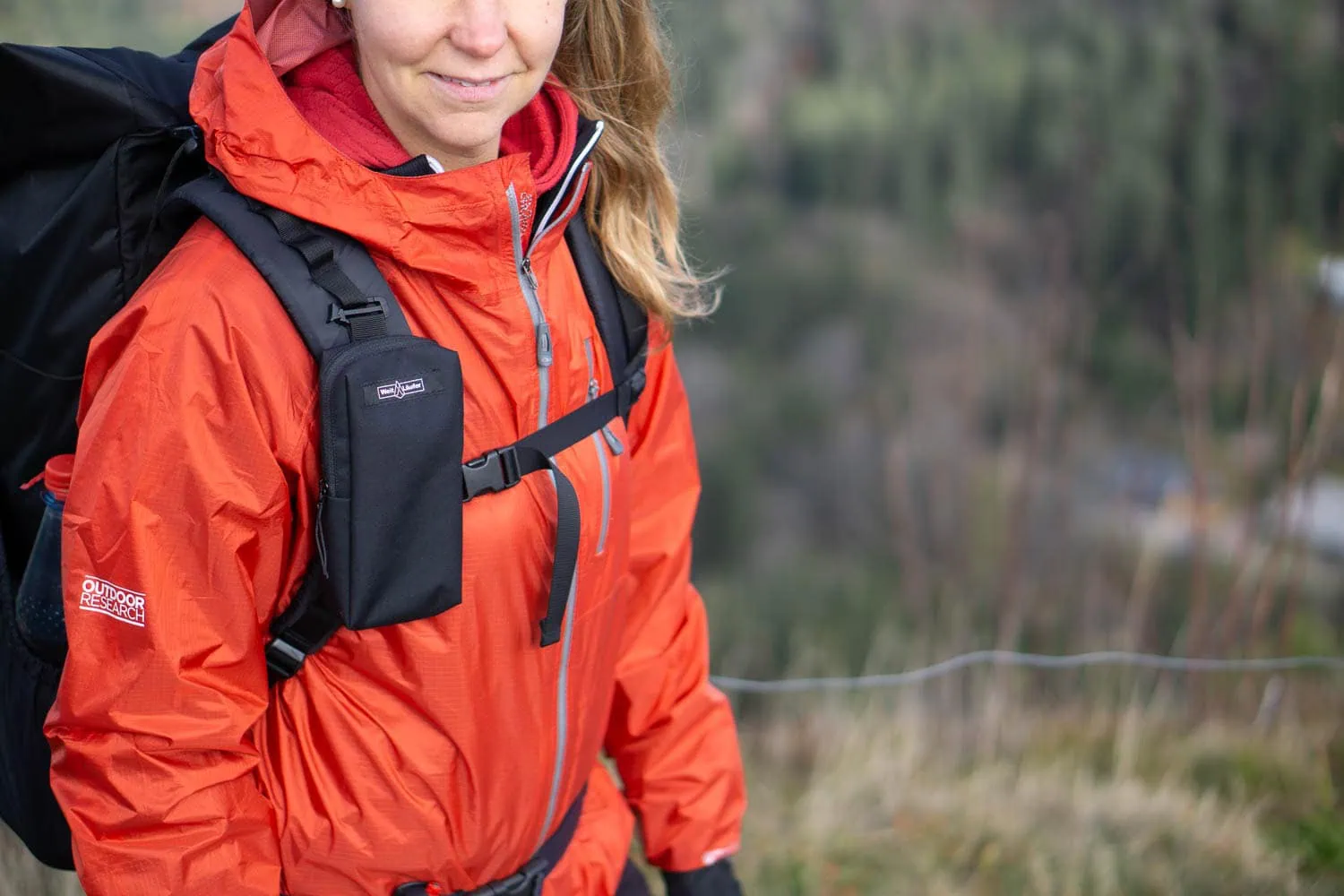
Low-set hand pockets constantly conflict with the hip belt of a rucksack. This is the classic among mis-purchases: in the shop the jacket feels perfect, on the trail the belt lies precisely on the zips. Look out for high-set pockets (Napoleon pockets on the chest) or consciously accept that the pockets will disappear beneath the belt. Many UL models solve the problem radically by almost completely omitting pockets.
length, cut, ladies' and gents' models
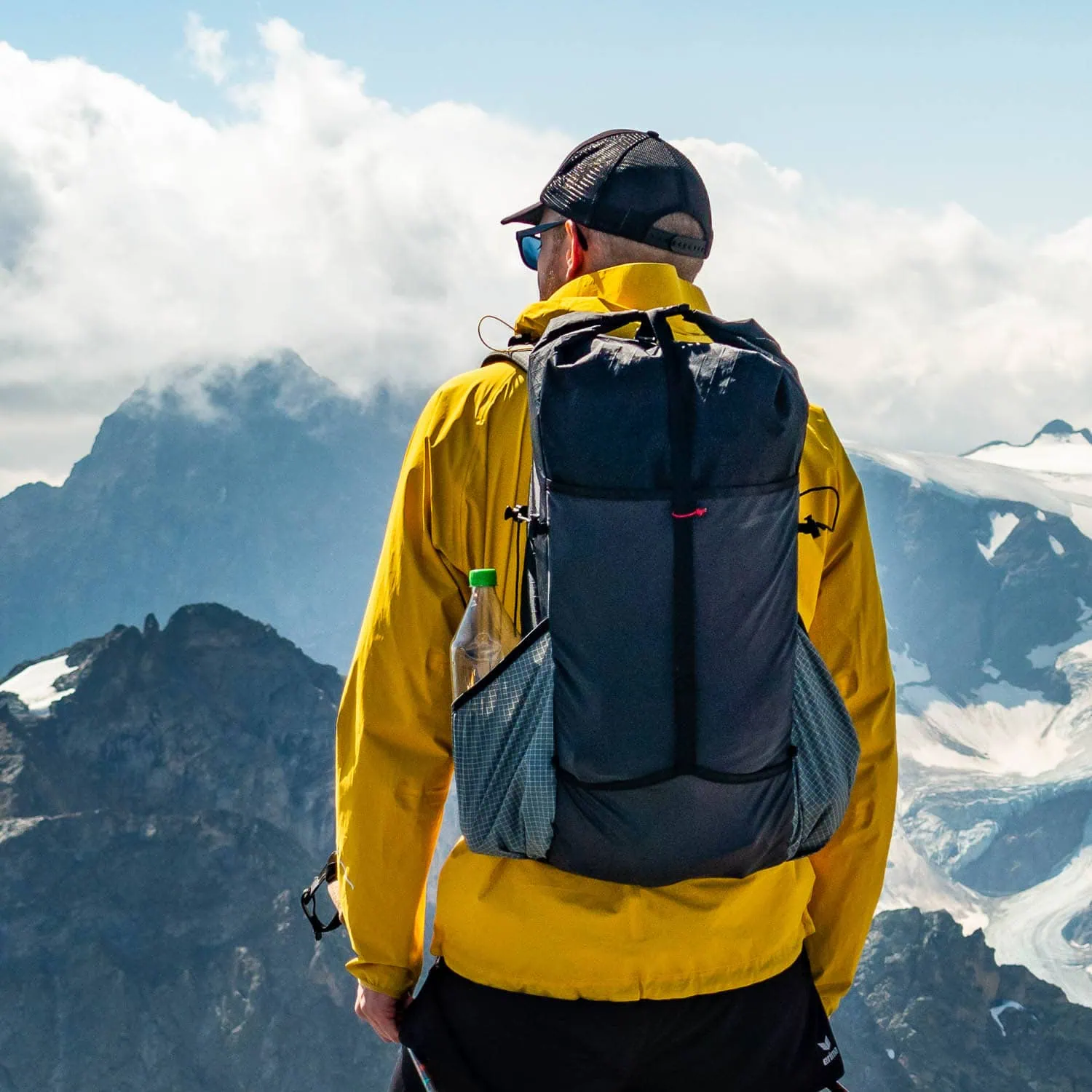
A jacket that reaches over the hips at the front and is cut slightly longer at the back keeps you noticeably drier in wind and driving rain, especially under a rucksack, which would otherwise push the hem up. Include an insulation layer in the sectionThe jacket must fit over a fleece or a thin down jacket in October without feeling tight at the shoulders. Ultraleighty waterproof jackets for women and men differ in shoulder width, sleeve length and waist tailoring; the membrane technology is identical. With very minimalist models, which are often only available as unisex, women generally do well choosing one size smaller than the conversion chart suggests.

PFAS ban: what has changed in terms of waterproofing since 2026
For a membrane to breathe, the outer fabric must repel water. This is handled by the DWR finish, which for decades was based on per- and polyfluorinated chemicals, or PFAS or PFCs for short. These substances practically never break down in the environment. Since 1 January 2026, the EU has been restricting their use in clothing and footwear, and by 2030 the regulation is set to be extended to all textiles.[2]
For you as a buyer, this means: new jackets come with a PFC-free finish, and when brand new it repels water just as well as the old chemicals. However, it is more sensitive to dirt, sunscreen and abrasion, and therefore wears off more quickly. Anyone who ignores maintenance will find that after one season they have a jacket whose outer fabric absorbs water. The membrane will still be waterproof, but breathability collapses and the jacket feels wet and cold.
Shelf life: how long will such a small amount of fabric last?
The fear that ultra-light rain jackets tear more easily is understandable, but usually unfounded. The thin 7- to 15-denier fabrics used in modern UL jackets are surprisingly tear-resistant, provided they are not constantly rubbing against something under load. My Active Shell jacket has spent 34 days on the Munich to Venice Dream Way It survived without any visible wear and tear, and the LIM series lasted for several years afterwards, even when carried in a rucksack. In my experience, the limit is: Does your rucksack weigh less than 8 to 9 kilograms?, you won't have any issues with durability. Anyone travelling with 20 kilos of luggage and metal belt buckles will wear through the shoulders of any lightweight jacket. In that case, the overall system doesn't suit the jacket, and a thicker fabric is the more appropriate choice.
And if a thorn should prick you after all: a hole in a waterproof jacket is not a death sentence. Self-adhesive repair patches weigh just a few grams, last for the lifetime of the jacket once applied, and have been a staple in my first-aid kit for years. A mended jacket that lasts another five years has a better carbon footprint than any new purchase.
The jacket is only half the battle
A perfect waterproof jacket keeps your upper body dry. Meanwhile, your sleeping bag, change of clothes and quilt are packed in your rucksack, which sits in a film of water for hours during continuous rain. Anyone who has ever spent the evening in a wet sleeping bag knows: dry gear is more important than a dry back. Therefore, think of rain protection as a system. For the lower body, lightweight waterproof trousers or even a rain kilt are sufficient on many trips, and for the rucksack, the most elegant solution is a pack that has most of its seams taped by default.
Frequently asked questions about the ultralight waterproof jacket
According to standard specifications, a fabric is considered waterproof from 1,300 mm of water column. For trekking with a backpack, this is cutting it too close because the straps exert pressure on the fabric. 10,000 mm or more is recommended, and established membrane jackets are usually around 20,000 mm and above.
The range is from just under 100 to about 300 grams. The sweet spot for trekking lies between 150 and 250 grams: a fully featured hood, full-length zip and sufficiently durable fabric at a minimal weight.
For everyday use, travel and as an emergency backup, yes. For trekking, no: hydrostatic head too low for the pressure of rucksack straps, rarely fully taped seams, rapidly aging coating. For multi-day trips, a membrane jacket is worth it from around 100 euros.
Yes, as long as the system is right. With a backpack weight of under 8 to 9 kilograms, even thin 7- to 15-denier fabrics will last for many years. Small holes can be permanently repaired with self-adhesive patches.
2.5-layer jackets are lighter and cheaper, but feel clammy against the skin more quickly. 3-layer jackets are more comfortable and durable, but more expensive. For occasional hikes, 2.5-layer is enough, whilst frequent hikers benefit from the 3-layer construction.
Wash with technical detergent after longer tours, activate the water-repellent finish with heat, and refresh it once or twice a season with a PFC-free wash-in proofing agent. Details can be found in the care section above.
Sources
- Explanation of the hydrostatic head and standard values according to DIN EN 343. bergzeit.co.uk
- German Alpine Club: „High Performance without PFAS“, Background to the EU PFAS restriction for apparel. alpenverein.de
- Montbell Versalite Jacket product data: 3-layer construction, 7-denier nylon, weight, PFAS-free DWR. montbell.com
- Market overview „10 Best Backpacking Rain Jackets“ with weights of current models. sectionhiker.com