
The packing list for a mountain hut tour begins with the best news there is when packing: the tent, sleeping bag, sleeping mat, and stove can remain at home. The hut provides the roof, mattress, blanket, and dinner. All that's left for you to pack is clothing, weather protection, and a few grammes of everyday essentials.
Still, on every tour I see people panting up to the hut with 50+ litre rucksacks and 12 kilos on their backs. None of them have anything exotic in there. It's just a accumulation of little „safety reserves“: the third T-shirt, the large toothpaste, the book for the evening, the heavy rain cover.
This list goes the other way. It has been compiled over years of actual multi-day tours, with each item individually weighed and much of it discarded. The result: a base weight of around 2.5 kg, about 5 kg on the scales with water and snacks. Less than half of what usual recommendations suggest as an upper limit.[1].
Packing List for a Mountain Hut Tour: Why You'll Be Lighter Than on a Trek
When trekking with a tent, 70 percent of the weight is in the „Big Four“: rucksack, tent, sleeping bag, sleeping mat. On a hut-to-hut tour, the hut takes care of three of those. What remains is a single decision, namely the rucksack itself.
This is precisely why the mindset from ultralight trekking is doubly worthwhile for hut tours. The base weight (everything excluding water and food) is already minimal here, so every single item has a noticeable impact. For those who, on a Ultralight pack list with tent Every gram is fought for, and on a mountain hut tour, you're rewarded with the result: a backpack you simply forget about on the ascent.
From the experiences of Dream Path Munich Venice carrying a heavy rucksack, I used this lightweight packing list to Stubaier Höhenweg walked and in 2017 from Vienna to Nice in four months, large parts of it from hut to hut. The list below has proven itself over roughly 2,500 to 3,000 kilometres.
The complete packing list with actual weights
All weights are self-weighed, no catalogue values. Your models will vary slightly; the order of magnitude per category is what matters. The list applies to catered mountain huts in the Alps, three seasons, 2 days to 4 weeks.
What you wear on your body does not count towards the base weight, but is included for the sake of completeness:
| Item | Weight | Manufacturer's comment |
|---|---|---|
| Mid-height hiking boots | ~900 g | After several thousand kilometres in mid-cut approach shoes, I prefer them to heavy boots. Surefootedness comes from leg muscles and practice, not from the shaft. |
| Hiking socks | 20 g | |
| Lightweight walking trousers | 108 g | A pair of thin running trousers will be perfectly sufficient for most mountain hut tours. |
| Merino T-shirt | 167 g | Merino doesn't smell after three days. That's more important on hut-to-hut tours than any gram optimisation. |
| Merino long-sleeved shirt | 230 g | Sun protection and second layer in one. |
| Cap and sunglasses | 89 g | |
| Trekking poles | 350 g | Enormous relief for the knees on hut tours with long descents. |
| Smartphone | 190 g | Map, weather report and hut phone numbers in one device. |
And now the actual backpack contents, category by category:
| Item | Weight | Manufacturer's comment |
|---|---|---|
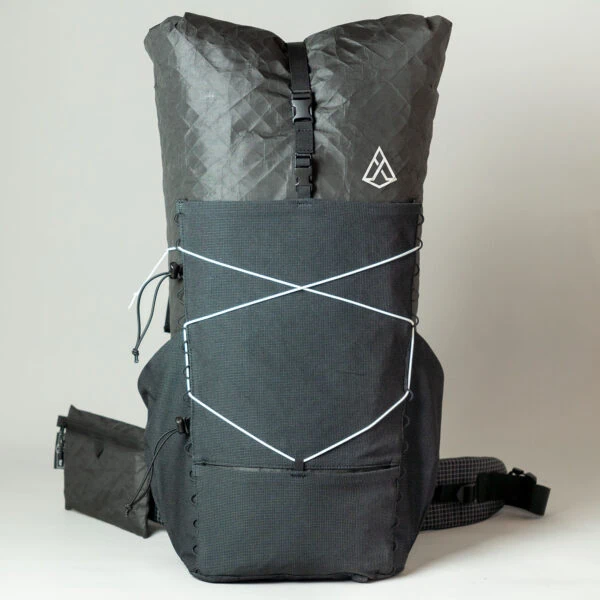
| WeitLäufer Minimalist, 30 L | 340 g | My frameless companion on many mountain hut tours. For 2 days to 4 weeks from hut to hut, 25 to 35 litres are easily enough. |
| WeitLäufer Agilist, 54 L | 570g | The alternative while the minimalist is still in development. Hip belt, fixed back padding, back lengths S to L. For hut-to-hut tours with more luggage or if you like carrying with a hip belt. |
| Dry bag for change of clothes | 15 g | Dry clothes are your insurance. Everything else can get damp. |
| Rucksack liner | 32g | An inner liner offers better protection than an outer rain cover and weighs just a third as much. With the Agilist, which has taped seams, you don’t even need that. |
| Item | Weight | Manufacturer's comment |
|---|---|---|
| Silk sleeping bag liner | 105 g | Mandatory on Alpine Club huts. Mine is self-sewn from parachute silk; shop-bought silk models cost between 110 and 150g. |
| Earplugs and eye mask | 3 g | The most important 3 grams of the whole list. Mattress camp snoring, always. |
| Mini headlamp Petzl e-lite |
26 g | For the trip to the camp, for peace and quiet and early starts. You won't need a large trekking headlamp here. |
| Item | Weight | Manufacturer's comment |
|---|---|---|
| Merino walking socks | 63 g | One pair on your body, one. |
| Functional underwear | 50 g | Same logic: wear one, wash one. |
| Long johns | 132 g | Nightwear and thermal protection in one. |
| Shorts for the cabin | 108 g | Getting out of sweaty hiking trousers in the evening is a luxury that costs almost nothing. |
| Fleece jumper | 230 g | For evenings in the mountain hut and chilly mornings. |
| Item | Weight | Manufacturer's comment |
|---|---|---|
| Rain jacket | 240 g | A lightweight 2.5-layer jacket is enough. In continuous rain you'll get damp anyway, what matters is the wind protection. |
| Rain kilt | 67 g | Instead of waterproof overtrousers: quicker to put on, better ventilation, half the weight. |
| Lightweight down jacket | 350 g | For the mountain hut terrace in the evening and breaks above 2,500 m. It can also snow up there even in mid-summer. |
| Item | Weight | Manufacturer's comment |
|---|---|---|
| Functional towel, essential | 52 g | Half a microfiber towel dries you just as well. |
| Liquid soap, 50 ml | 50 g | Wash yourself and your merino shirt. Two products, one bottle. |
| Toothbrush and dental tabs | 12 g | Toothpaste tablets instead of a tube: no leaks, precisely dosed. |
| Sunscreen, 50 ml | 58 g | At height, non-negotiable. Small quantity, can be repurchased on the go. |
| Deodorant and skin cream | 76 g | Hirschtalg to prevent blisters before they form. |
| Toilet paper | 10g | |
| First-aid kit | 65g | Blister plas. |
| Item | Weight | Manufacturer's comment |
|---|---|---|
| Charger and cable | 53 g | Almost every managed mountain hut has power sockets. You can usually leave your power bank at home. |
| Emergency bivouac bag | 108 g | Non-negotiable. If the weather turns and progress becomes impossible, it will keep you warm overnight. |
| 2 plastic bottles of 1 L each | 58 g | Lighter than any hydration bladder and can be filled at any water tap in seconds. |
| Water filter | 59 g | To refill from streams between the huts. I avoid pasture areas and glacial streams. |
| Cushion | 22 g | Against a wet bum at break time. 22g of pure comfort. |
| Hat and light gloves | 93 g | A must-have in any rucksack in the Alps, whatever the month. |
| Map and compass | ~60 g | When the battery is dead, paper is your backup. |
| Category | Weight |
|---|---|
| Rucksack and packing | 387 g |
| Hut kit | 134 g |
| Change of clothes | 583 g |
| Weather protection and warmth | 657 g |
| Hygiene and Pharmacy | 323 g |
| Electronics and Miscellaneous | 453 g |
| TOTAL BASE WEIGHT | 2,537 g |
With two litres of water and snacks for the day, you'll weigh around 5 kg. For comparison, the common recommendations suggest about 8 kg as a good target and 12 kg as the upper limit.[1]. So it's much easier, without you missing anything at the hut.
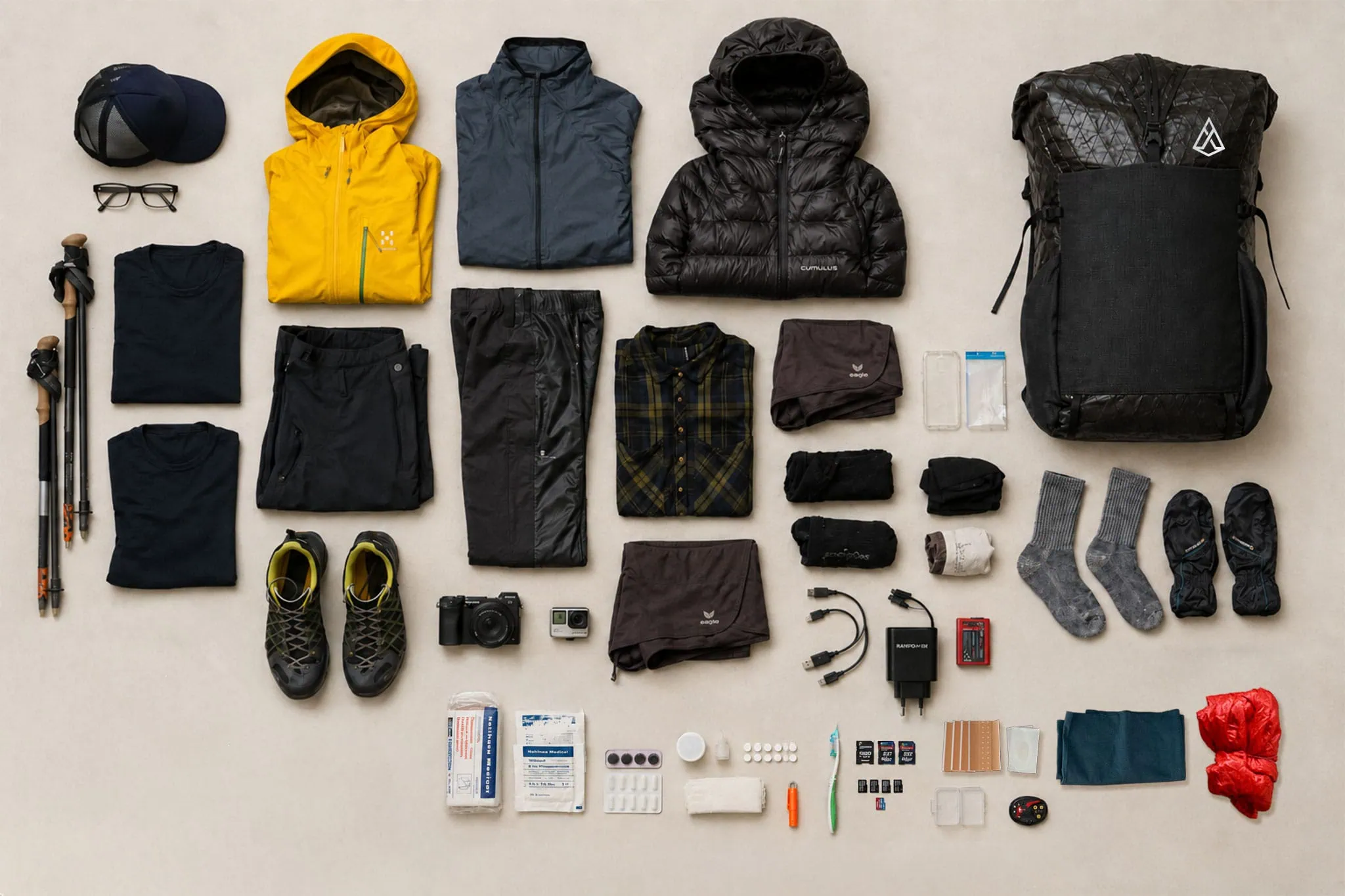
This is how the weight is distributed across the categories:
~900 g
350 g
230 g
190 g
167 g
108 g
89 g
20 g
The Cabin Essentials in Detail
Three things distinguish a hut-to-hut touring packing list from any day touring list. Together they weigh no more than 150 grams, but they determine how good your nights will be.
Sleeping bag liner: the essential that weighs next to nothing
In Alpine Club huts, a sleeping bag liner is mandatory for all beds, for hygiene reasons, as blankets and pillows are not washed after every night.[2]. There’s no point in arguing; the hut owners know every excuse.
Lodging slippers: you can usually do without them
On the Munich-Venice trek, I brought along some extra shoes for the huts, and even then, I found slippers at every single hut that I preferred to wear. Since then, hut shoes have stayed at home. Almost all catered huts provide Crocs or felt slippers, as mountain boots have to stay in the shoe room. If you want to be on the safe side: flip-flops, weighing around 150g, are all you need.
Earplugs, headlamp, cash
Earplugs and an eye mask weigh three grams and save your night in the dormitory, I write this from painful experience. The head torch belongs within easy reach in the lid pocket: after lights out in the hut, it is your only light for the dormitory.
And take enough cash for the whole tour. Many mountain huts do not accept card payments due to poor signal, and the DAV strongly recommends bringing sufficient cash.[3]. As a general rule, I budget 70 to 100 € per mountain hut day, including half-board and drinks, and I've never got into trouble.
How big does a rucksack need to be for a hut-to-hut hiking trip?
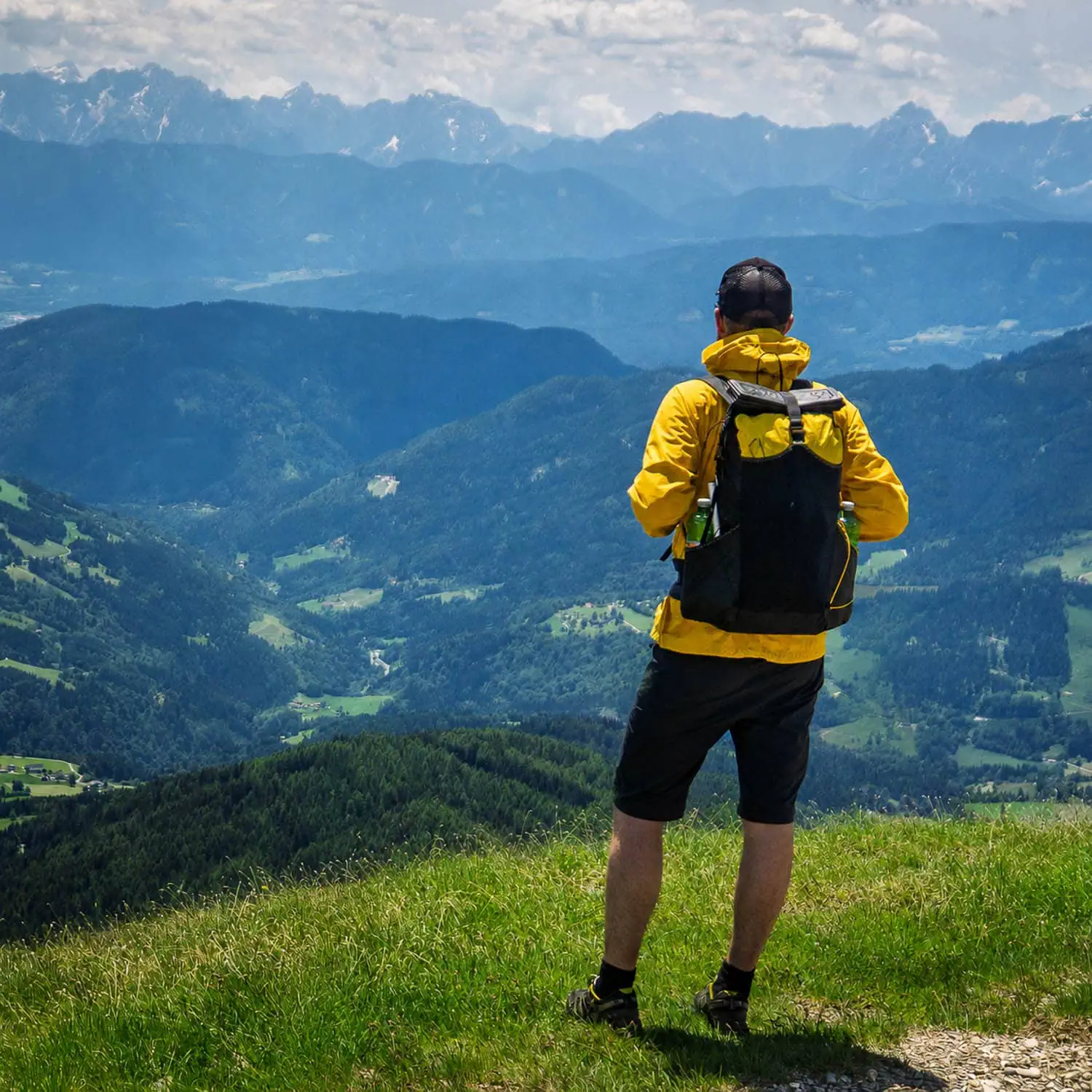
Shorter than most people think: 25 to 35 litres are sufficient for 2 to 5 days of hut-to-hut hiking. The list above fills a 30-litre backpack to about two-thirds capacity, and that's a good thing. In our experience, the empty space in an oversized backpack fills itself with things you never need.
You only need more volume if additional equipment is added: a via ferrata set, crampons for a glacier crossing, or children's equipment. Then 40 litres makes sense, but no more than that. You can find a detailed overview of which size suits which tour in the guide. Small hiking backpack.
Meals: The hut is your kitchen
The second big difference to a tent tour: You don't have to carry food for several days. Breakfast and dinner come from the hut, and half-board is almost always the right choice for multi-day tours. Many huts will even pack you a lunch for the stage if you wish.
Nevertheless, a small reserve for along the way should go into the rucksack: nuts, a few bars, perhaps a bar of chocolate. I plan for about 100 to 150 g of snacks per day and buy more if the path leads through a valley village. That's all you need, because the next stop on hut tours is rarely more than half a day away.
There is one exception: self-catering huts. There, you’ll need to bring your own food and, depending on the facilities, a camping stove too, so the packing list becomes more of a short trekking checklist. Check before your trip which huts along your route are staffed. On classic routes such as the Stubaier Höhenweg or the Tour du Mont Blanc, this isn’t an issue, as the huts along the route are staffed during the season.
This way your backpack stays under 5 kilos
The list is the result, but the method behind it is more important. Six principles that turn a 10kg backpack into a 5kg backpack:
Weigh everything. Really everything.
A kitchen scales costing from €8 is your most important packing tool. Only when you know that your towel weighs 180 g and the cropped one weighs 52 g can you make an informed decision. When designing our rucksacks, we weigh every piece of webbing individually, and exactly the same logic applies to your packing list.
Wash instead of stacking.
One set on the body, one set in the rucksack, washed in the evening. Merino dries overnight on the hut's washing line and doesn't smell even after three days. The third T-shirt is the heaviest, as it sets the precedent for everything else doubled up.
Remove everything you didn't use last time.
My e-reader (362g) flew out after I'd read for perhaps half an hour in total across all the tours. I didn't need the pocketknife (116g) a single time on the entire journey from Munich to Venice. Taking stock honestly after each tour – that's the most effective diet for your rucksack.
Eliminate packaging.
Toothpaste tablets instead of a tube, soap in a 50 ml bottle, sunscreen small instead of a family pack. Laughable individually, 200 to 400 g in total. Replenishments are available in every valley town.
Use the hut as equipment.
Half board replaces stove, pot and food supplies. Sockets replace the power bank. Sliders replace mountain hut shoes. Blankets replace the sleeping bag.
Top up your water on the go.
A litre of water weighs as much as a third of this packing list. With two 1-litre bottles and a 59g filter, you'll refill at springs and streams and never start the morning with more than two litres. In the Alps, the next water source is rarely far away.
Frequently asked questions about the hut-to-hut tour packing list
Yes, on Alpine Club huts, a sleeping bag liner is mandatory for all sleeping spots for hygiene reasons. A silk model weighs 110 to 150g and packs down to the size of a fist.
Common recommendations suggest around 8 kg as a good target and 12 kg as an upper limit. With a consistently weighed list, around 5 kg including water is realistic, without foregoing provisions at the hut.
25 to 35 litres are sufficient for 2 to 5 days of hut-to-hut trekking. 40 litres only make sense if additional equipment such as a via ferrata set is included. More on this in the guide. Small hiking backpack.
Usually not. Almost all managed mountain huts provide slippers or felt slippers, as hiking boots must be left in the shoe room. If you want to be on the safe side, bring light flip-flops weighing around 150g.
Not everywhere. Due to poor connections, many mountain huts only accept cash payments. Plan to have enough cash for the entire tour; as a rough guide, budget between 70 and 100 euros per hut day including half board.
Yes, on popular routes, and in peak season, sometimes months in advance. Make a firm booking and cancel promptly if your plans change; this is a matter of honour in mountain huts and may sometimes be subject to a charge.
Sources
- Bergzeit Magazine: Hut Tour Packing List, recommendation of around 8 kg rucksack weight, a maximum of 12 kg. bergzeit.co.uk
- German Alpine Club: Guests at Alpine Club huts, sleeping bag required for all beds. alpenverein.de
- German Alpine Club: Packing list for an overnight stay in a mountain hut, recommendations on cash and equipment. alpenverein.de