At Backpack for the Way of St. James The most important decision is made before you even go into a shop. The decision is: Where do you sleep? Whether you go five stages from Sarria or five weeks from Saint-Jean-Pied-de-Port, it changes the content surprisingly little. From the third evening on, you are already living in the rhythm of washing, drying, and moving on anyway. Accommodation and season determine the volume, who hardly ever drives kilometers.
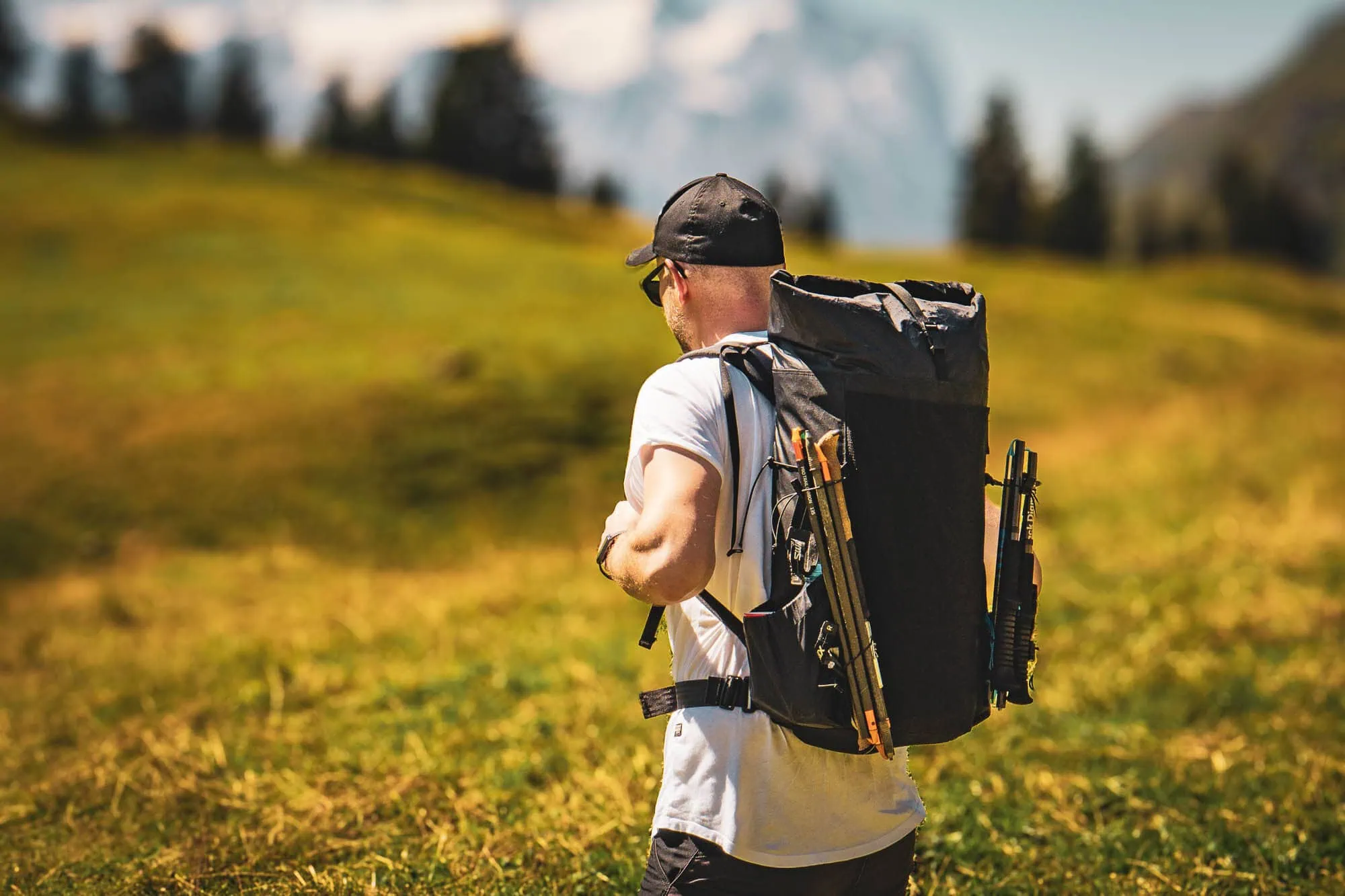
We develop ultra-lightweight backpacks ourselves in Emmendingen, Our own model is therefore shown marked here.. The purchase criteria apply to every brand, however: the number of liters, the empty weight, the length from the shoulder to the hem, and a few details that count more on the Camino than in the catalog. What ends up going into the backpack is stated in our Camino packing list.
Which backpack for the Camino de Santiago? First the accommodation, then the liters
The large backpack test on jakobsweg.de compared 18 models with around 12 kg of luggage and recommends 35 to 40 litres.[1] For the classic Camino Francés with overnight stays in hostels, this is a useful upper limit. For many other forms of pilgrimage, it is too much, and a backpack with empty space tempts you to fill it up.
The calculation is simple. Anyone who sleeps in pensions, hotels, or convents doesn’t need a sleeping bag or a towel the size of a bath towel. In Spain’s hostels, at least one lightweight sleeping bag is included, and in spring and autumn a warmer plus insulation jacket. Cold costs volume, And that’s more than any additional stage.
| Pilgrim form | Volume | What determines the place |
|---|---|---|
| With luggage transport | 15 to 20 l | Water, rain jacket, snacks, pilgrim pass. The rest of the group travels from accommodation to accommodation. |
| Pension or hotel | 25 to 30 l | No sleeping bag, just a set of change clothes. Typical for the Munich or Franconian Way of St. James. |
| Albergue, May to September | 30 to 38 l | Light sleeping bag or sleeping mat, small towel, slippers. The classic Camino setup. |
| Albergue, spring and autumn | 35 to 45 l | Warm sleeping bag, insulating jacket, long underwear. The nights in the Meseta and in Galicia are cold. |
| Winter or with a tent | 45 to 55 l | Sleeping bag for temperatures around the freezing point, plus tent or tarp and an insulating mat. Many hostels are closed in winter. |
A large part of the pilgrims falls into the small categories. In 2024, almost Every third Compostela pilgrim in Sarria, That is, for the last 100 kilometers or so.[2] Anyone who goes on these five stages with a camping tent is well served with 25 liters. The 40-liter backpack from the test field would be half empty on those stages.
I have experienced for myself that the length of the journey does not determine the volume. On my Alpine journey from Vienna to Nice in 2017, I was 107 days While traveling, we usually stayed in huts and mountain lodges. Our basic equipment weighed in at 4.3 kg, Including a tent that we set up for about 15 nights. After the first week, the contents had settled down and remained almost the same throughout the Mediterranean.
How heavy can a backpack be on the Way of Saint James?
Bergzeit for the packed pilgrimage backpack maximum 10 kg including water and provisions an.[3] For most pilgrims, the more comfortable mark is below that, at about 10 percent of body weight. At 70 kg, that’s 7 kg. And this is where a point comes into play for the Jakobsweg backpack, which many guides skip: the weight of the backpack itself.
The favorite in the aforementioned test, the Deuter Aircontact 40+10, weighs according to the manufacturer’s specifications 2.35 kg, before only one part is inside.[1] At a target weight of 7 kg, that’s a third. The backpack is built with an aluminum frame and mesh back for heavy loads, and it does a good job. The question remains, though, whether you’ll be carrying such loads on the Camino at all.
| Design | Unloaded weight | Examples and classification |
|---|---|---|
| Hiking backpack with frame, 40 to 55 l | ~1.8 to 2.5 kg | For example, Deuter Aircontact 40+10 (2.35 kg). Built for 12 kg and more, usually oversized on the Camino. |
| Hiking backpack with mesh back panel, 30 to 38 l | ~1.3 to 1.9 kg | For example, Deuter Futura 32 (~1.4 kg) or Osprey Kestrel 38 (~1.85 kg, retailer information). Good ventilation; the weight is contained in the webbing frame. |
| Lightweight hiking backpack without mesh, 30 to 40 l | ~0.8 to 1.2 kg | For example, the Vaude Zerum 38 LW (860 g according to jakobsweg.de). Foam padding on the back, for loads of up to about 10 kg. |
| Ultra-light backpack without frame | ~0.5 to 0.8 kg | For example, ours Agilist (570 g, 54 l). It comfortably carries up to 13 kg, requires careful packing. |
An example calculation for the Camino Francés in May, including accommodation in hostels, shows how much this costs. The values are rounded values for light, but not extreme, equipment.
| Block | Weight |
|---|---|
| Backpack (ultra-light, without wheels) | ~570 g |
| Light sleeping bag for the hostel | ~600 g |
| Clothes in the rucksack | ~1.300 g |
| Rain jacket | ~300 g |
| Hygiene and First Aid | ~500 g |
| Mobile phone, charger, pilgrim passport, money | ~500 g |
| 1 liter of water and snacks | ~1.300 g |
| PACKED TOTAL | ~5.1 kg |
The same content in the 2.35 kg trekking backpack weighs the same. just under 6.9 kg. That's still bearable. But you carry the difference over every one of the roughly 780 kilometers, and it sits exactly at the point where the shoulders start to complain after two weeks. What's actually going on in these blocks is listed in the Camino packing list Part by part up.
Length and fit: more important than the number of sheets
A backpack with perfect volume is useless if the hip belt is sitting on the belly instead of the pelvis. Then the weight falls on the shoulders, and after 25 kilometers you feel it twice as much. Don't miss your waistline when choosing a model: from the prominent C7 vertebra to the top edge of the pelvic arch. How to do this at home with a measuring tape and a second person is explained in our guide to measure back length.
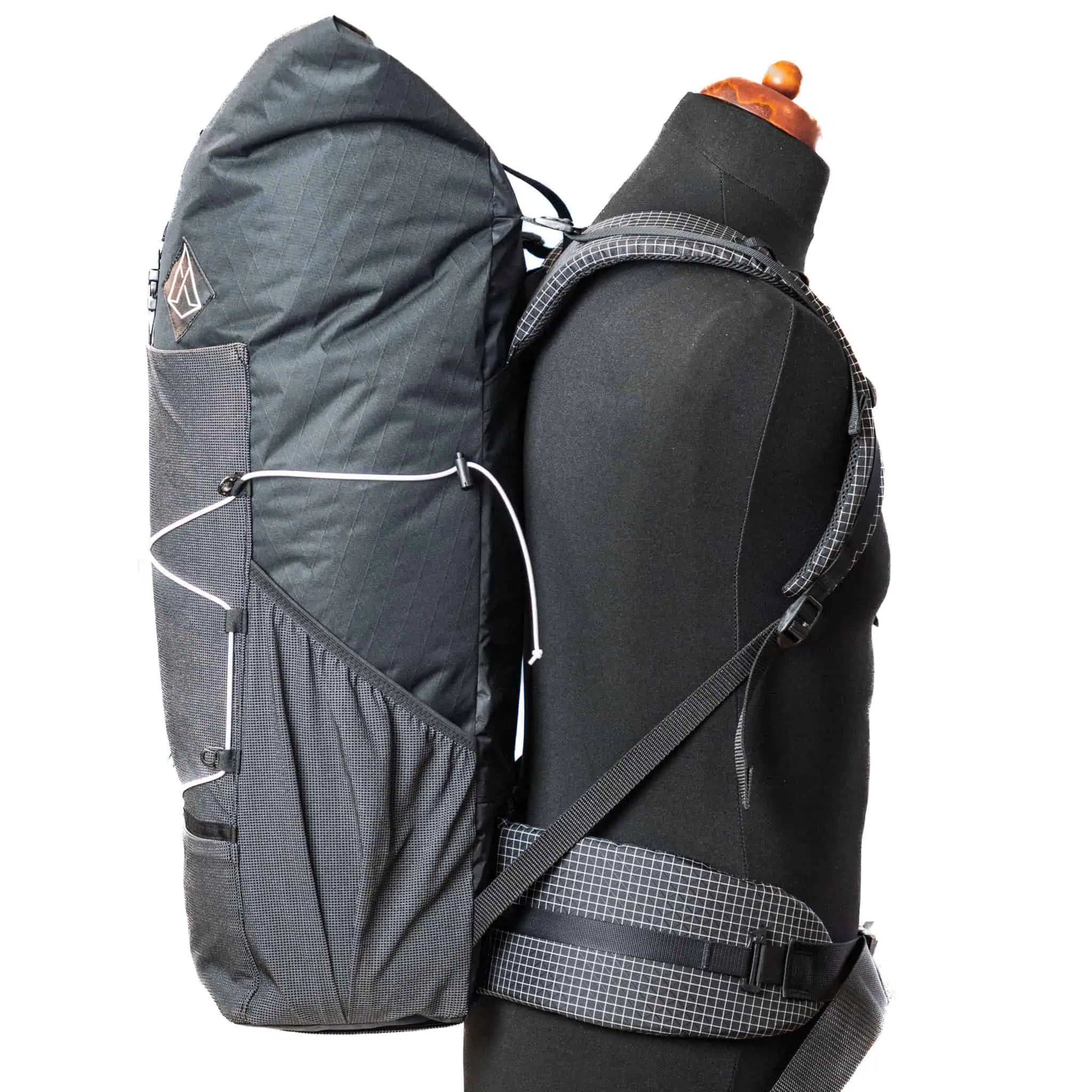
After that: The hip belt carries most of the load; the shoulder belts only carry it. The straps should be tight at the top, without any air above the shoulder, and the load control straps should run in a flat angle towards the back. Pack your backpack with your real equipment before the trip and walk for two hours with it; it’s best to do it with a few stairs. The pressure points don’t show up until the afternoon.
Backpack for women on the Way of St. James
Many manufacturers offer women's models, such as the SL variants from Deuter or Kyte and Eja from Osprey. They usually have a shorter back length, narrower shoulder straps and a more conical shaped hip strap. This suits many women better, but not everyone. In the end, it’s about whether the back length and belt shape fit your body, regardless of what the label says.
That’s why it’s worth looking at sizes rather than gender. A unisex backpack with the right length of back straps and S-shaped shoulder straps often fits better than a women’s model with the wrong ones. We Agilist offer three sizes: S for 40 to 43 cm, M for 43 to 53 cm, L for 53 to 59 cm Length from the back. If you are between two sizes, choose the larger size and adjust the seat to the load control straps.
Equipment that counts on the Camino
Catalogues list compartments and loops. On your journey, you quickly notice which ones you use daily. In our experience, these six details make the difference.
Bottles that you can reach while walking.
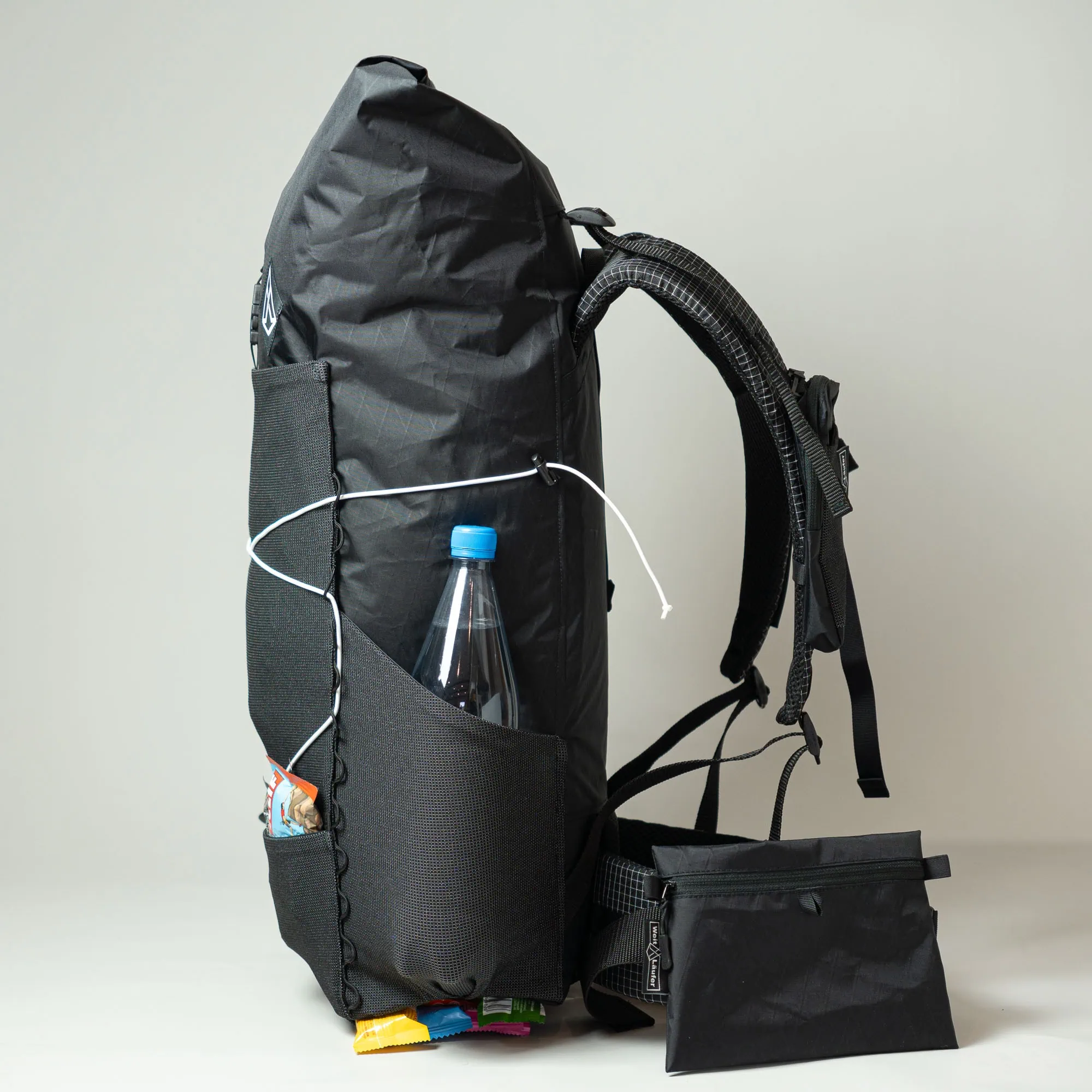
Side pockets where you can pull out the bottle without having to take off the backpack. Otherwise, you’ll drink too little on the shaded stretches between Burgos and León. How much water you need in the heat is outlined in our guide. Hiking in hot weather.
A place for pilgrim passport and mobile phone.
A hip belt or shoulder belt pocket saves you from having to take it off for every stamp and every photo. Also, keep the pilgrim passport in a small zip pocket to protect it from rain and sweat.
Rain protection that matches the material.
A backpack made of coated nylon needs a rain cover or a pack sack inside in Galicia. A waterproof laminate with taped seams doesn’t need a cover; in the wind on the way to Santiago it’s pleasant.
Quickly packed in the dark.
In many hostels, you pack in the morning alongside sleeping people. A large opening and few packs in solid colors help more than ten small compartments that need to be searched through noisily.
Hangers for the hiking poles.
On asphalt and in towns, you often carry the poles on your backpack. Side loops or cords that you can use without having to take them off are ideal for this purpose.
A hip belt that really works.
A backpack without a hip belt or with thin webbing is built for day trips. Starting at about 5 kg of luggage, a padded hip belt is included; otherwise, the shoulders carry everything alone.


Backpack as carry-on luggage for the flight to Spain
Most pilgrims from Germany fly to Bilbao, Madrid, Biarritz, Porto or Santiago. Those who only travel with carry-on luggage save the waiting time at the airport and the risk that their backpack arrives a day later. In return, they must fit into the cabin dimensions, which is the case for almost all airlines at 55 cm height.[4]
| Airline | Cabin baggage | Note |
|---|---|---|
| Ryanair | 55 × 40 × 20 cm, 10 kg | Only with extra charge (Priority). Only one piece is free, with dimensions of 40 × 30 × 20 cm. |
| Vueling | 55 × 40 × 20 cm, 10 kg | Only with extra charge. A piece measuring 40 × 30 × 20 cm is free of charge. |
| Eurowings | 55 × 40 × 23 cm, 8 kg | Depending on the tariff, with an additional charge. |
| Iberia | 56 × 40 × 25 cm, 10 kg | Included in the most favorable tariff. |
| Lufthansa | 55 × 40 × 23 cm, 8 kg | Depending on the tariff, with an additional charge. |
| Condor | 55 × 40 × 20 cm, 8 kg | Depending on the tariff, with an additional charge. |
Weight is rarely the problem; a well-packed pilgrimage backpack weighs less than 8 kg. The height is another matter. Classic hiking backpacks with 32 to 50 liters are often 65 to 76 cm long, The Aircontact 40+10 is about 74 cm. The frame and the main compartment cannot be compressed together. A backpack without a frame with a roll top lid, on the other hand, is as high as you roll it up: it Agilist measures 55 × 28 × 17 cm, and when fully rolled up it grows taller, so roll down deeply before the flight and tighten the compression cord.
Two things do not belong in the cabin. Walking sticks end up on the list for checked baggage on many airlines, and at the security check, the staff ultimately decides. Plan them for the carry-on luggage or buy cheap sticks locally. The pocket knife stays at home or is included in the checked baggage. Check your airline's rules shortly before departure; they change more often than the waymarks.
When is the Agilist right size and when is a smaller backpack better?
Honestly put it this way: With 54 liters, the Agilist for a pilgrimage week with pension rooms Larger than necessary. Anyone who travels exclusively this way is better off with a smaller backpack. Which backpacks are available in 30-liter sizes and what you should pay attention to are outlined in our guide to Small hiking backpack. Our own smaller model, the Minimalist, is currently not available for purchase.
He plays to his strengths Agilist where the volume shifts. In the hostels with sleeping bags, in March or October with a warmer layer, on the Camino del Norte with more rain and more elevation gain, or when the Camino de Santiago is only part of a longer journey. The empty weight is with 570 g in many 30- to 38-liter pilgrimage backpacks. And because the Rolltop is rolled up, it also fits compactly on the back with its 30-liter capacity.
Wherever you buy the backpack, order it early for two or three trial rides. We offer a 14-day return policy so you can pack it at home and try it out. 3 year warranty with repair WeitLäufer Lab in Emmendingen. It is manufactured Agilist in a specialized high-tech production facility in Vietnam and shipped directly from Germany. All models in this weight class, including those from other manufacturers, can be found in our comparison. Lightweight hiking backpacks.
Luggage transport: when the backpack is transported in the transporter
On the main Spanish routes, the Spanish Post offers transport from accommodation to accommodation with the Paq Mochila service. Drop-off until 8 a.m., delivery by 2:30 p.m., maximum 15 kg per piece of luggage. The route from Sarria to Santiago costs a total of 30 € per backpack.[5] In addition, there are private providers on practically all sections of the Camino Francés.
For pilgrims with knee or back problems, this is a real option, and then a backpack is all that is needed. Daypack with 15 to 20 liters. Those who can pack light rarely need it.
Frequently Asked Questions
That depends on the accommodation. Those who sleep in pensions and hotels need 25 to 30 liters. In Spanish hostels with their own sleeping bags, 30 to 38 liters are reasonable in summer, 35 to 45 liters in spring and autumn.
Packed no more than about 10 kg, Around 10 percent of your body weight is comfortable. The empty weight of the backpack should be as low as possible, otherwise it eats up a large part of that budget.
Yes, if you sleep in retirement homes Or in the summer, you spend the night in hostels in a lightweight sleeping bag and wash clothes on the go. In spring, autumn and winter, you’ll be a little short on warm sleeping bag and insulation jacket.
One whose back length and hip belt shape fit. Women's models often have shorter backs and more conical hip belts, but a unisex backpack in the right size often fits just as well. Measure your back length before purchasing from the C7 cervical vertebra to the coccyx.
Yes, if it fits the cabin dimensions, At most airlines, the dimensions are 55 × 40 × 20 cm. Classic hiking backpacks with a frame are often too long for this purpose; upright backpacks with a roll top lid can be rolled up properly. Walking sticks and pocket knives belong in the carry-on luggage.
In the case of a backpack made of coated nylon, yes, Or alternatively, a waterproof inner pack bag. Backpacks made of waterproof laminate with taped seams protect the main compartment even without a cover.
Sources
- jakobsweg.de, Rucksacktest Jakobsweg (18 models, test luggage around 12 kg, recommended 35 to 40 liters) and individual test Deuter Aircontact 40+10 (2.35 kg, 74 cm). jakobsweg.de
- Metropolitano.gal, Pilgrim statistics 2024 based on the Oficina del Peregrino (starting point Sarria around 32 percent). metropolitano.gal
- Bergzeit Magazine, packing list for the Camino de Santiago (weight limit 10 kg including food and water). bergzeit.co.uk
- Stiftung Warentest, Hand luggage in airplanes, dimensions and weights of airlines, as of September 2026. test.de
- Correos, Frequently asked questions about the Paq Mochila (15 kg, delivery by 8 am, Sarria to Santiago 30 €). elcaminoconcorreos.com